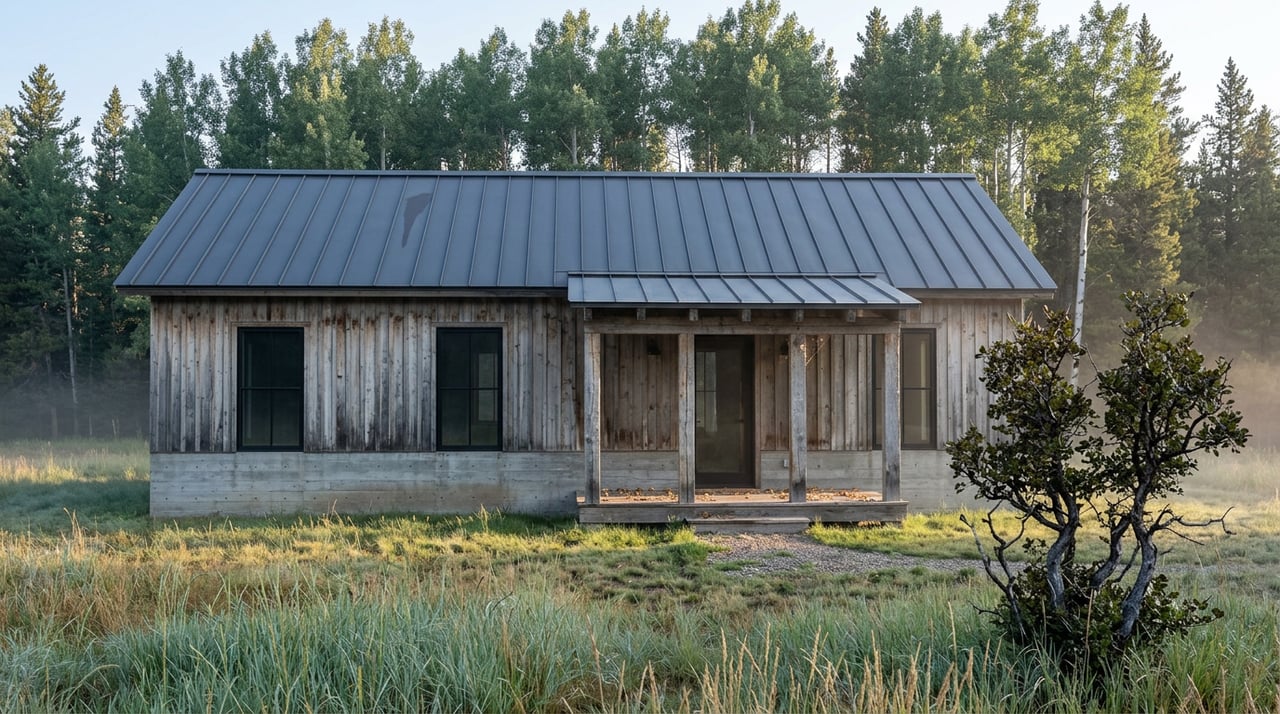
The listing photo shows two acres of sage and cottonwood a few minutes from downtown Hailey, priced well below anything comparable inside the city limits. Then, somewhere in the purchase agreement or a lender's checklist, a phrase shows up that nobody mentioned at the showing: domestic exemption. What that phrase means, and what it costs to satisfy, is the actual difference between what an acre near Hailey looks like it costs and what it costs once you close.
Most land outside Hailey's city limits has no connection to municipal water or sewer. That is not an oversight in the listing. It is the baseline condition of nearly all unincorporated Blaine County, where the closest thing to a rule is a policy South Central Public Health District has enforced since 1977, based on an early EPA manual, requiring roughly a one-acre septic field for any lot that is not tied into sewer and water infrastructure. Blaine County's own subdivision infrastructure code still requires septic systems built with inspection risers, access ports, and a maintenance obligation recorded on the plat itself, so the buyer, not the county, carries responsibility for what happens underground.
You can see this pattern in the parcels currently on the market around town. A 20-acre patented mining claim up Croy Canyon comes with off-grid living, seasonal road access, and a Mountain Overlay District cap limiting any home built there to 1,200 square feet. A 2.34-acre lot in the Stonegate subdivision advertises Baldy views and privacy, with no mention of a water source in the description. A 1.79-acre parcel in the Old Cutters neighborhood offers direct trail access and a private pond, part of the same corridor where nearby land listings routinely carry the fine print every rural buyer eventually has to research: water to be domestic well and private septic. Even Glendale North, a seven-lot subdivision that went through Blaine County's engineering review this past October, was designed around individual subsurface septic systems for every residential lot, with a geotechnical report and test pits required before the county's health district would sign off.
None of that shows up as a line item on a listing sheet. It shows up later, as a bill.
What the well and septic actually cost
Rural Idaho contractors this year are quoting combined well-and-septic installs somewhere between $18,000 and $45,000, depending on how deep the water sits and how the soil drains. That is before the county's own conservation rules kick in. Blaine County's subdivision code requires any new lot relying on domestic water for irrigation to cap lawn watering at an eighth of an acre and total irrigation at a quarter acre, and asks developers to build in drought-tolerant landscaping from the start. In other words, after a buyer pays to put water on a rural lot, the county limits how much of that water they are allowed to spread on the ground.
That is the first hidden cost. The second is timing, and 2026 made timing considerably less predictable.
Why 2026 changed the math
Idaho's winter of October 2025 through March 2026 was the second warmest on record dating back to 1896, beaten only by the winter of 1933 to 1934. Snowpack in Idaho peaked on March 17, about three weeks earlier than normal, and by mid-April the Big Wood Basin's snow water equivalent sat at 8.1 inches, nearly five inches below its median peak. Blaine County Commission Chair Angenie McCleary asked the Idaho Department of Water Resources for a drought declaration on April 2, and on April 13, IDWR Director Mathew Weaver and Governor Brad Little declared a statewide emergency covering all 44 counties, as reported by the Idaho Mountain Express. That declaration runs through the end of this year unless extended, and it adds groundwater monitoring scrutiny to new water right applications under Idaho's statewide technical guidance rules, the same rules every one of the state's seven public health districts, including the one covering Blaine County, applies when reviewing new septic and well permits.
Layered on top of that is a legal change that has nothing to do with rainfall. In 2025, the Idaho Legislature passed Senate Bill 1083a, revising several statutes covering domestic water use, shared wells, and subdivisions. This February, lawmakers went further. Senate Bill 1222, signed by Governor Little on February 17, 2026, revised the statutes governing Idaho's "domestic exemption", the provision that lets a rural landowner drill a well and establish a water right by use rather than by applying to IDWR for a permit first. Two statutory changes to the same exemption in two years means the paperwork a buyer's well driller filed on a neighboring lot last summer may not describe the process required on the lot next door this fall.
A dispute that already happened once
None of this is theoretical in the Wood River Valley. A few years ago, a developer called Quigley Farm and Conservation Community LLC proposed drilling 24 individual wells and septic systems, one per home, for a subdivision called Quigley Ranch east of Hailey in Quigley Canyon. The land sits just outside the boundary of Quigley Farm's own 2017 annexation into the city, which means the newer proposal remained under county jurisdiction rather than Hailey's municipal water system. More than 460 public comments came in on the application, and water was the first concern raised, not the last.
Wendy Pabich, a Hailey resident who founded the water consultancy Water Futures, put the underlying problem in plain terms during that public comment period:
"The Big Wood basin has been overallocated since the turn of the last century."
She argued the state had done little to track the cumulative effect of domestic exemption wells on the basin, even as drought years stacked up and existing wells in the tributary canyons started showing problems. That fight predates the 2026 drought emergency by several years. It is worth remembering now because it shows the aquifer conversation in Blaine County was already strained before this year's record-low snowpack, not after it.
What this means if you are pricing an acre near Hailey
The discount on an outlying parcel is real, but it is a discount on land, not on the total cost of making that land livable. A buyer comparing a $650,000 in-town Hailey lot on municipal water against a $500,000 two-acre parcel in an unincorporated pocket of the county needs to add the well, the septic, the perc test, and this year's monitoring timeline before the comparison means anything. In a normal water year, that math is inconvenient but predictable. In a year with a standing drought emergency and a freshly revised domestic exemption statute, it is inconvenient and slower, and slower has its own cost if a buyer is financing construction on a schedule.
Before making an offer on acreage outside Hailey's service area, it is worth confirming a short list of things directly:
- Whether a well has already been drilled and permitted on the parcel, checked against IDWR's own well records rather than taken on the seller's word
- Whether an existing septic system has documented inspection and pumping history, or whether the lot is raw and will need a new site evaluation
- Whether the parcel falls inside Blaine County's Area of City Impact for Hailey, which affects whether future annexation and municipal hookup are even possible
- Whether a perc test has been completed on the specific lot, since a failed test on a neighboring parcel says nothing about the one you are buying
- Whether the purchase contract makes water and septic due diligence a contingency, not an assumption
A short FAQ
Does every acre-plus parcel near Hailey require a private well and septic? Only if it sits outside Hailey's municipal water and sewer service area. Some annexed parcels, including portions of Quigley Farm itself, are tied into city systems. Confirm service boundaries with the city and county before assuming either way.
What exactly is a domestic exemption well? It is the legal path that lets a landowner drill a well and establish a water right through use, without first applying to the Idaho Department of Water Resources for a permit. The statute defining it changed in 2025 and again in February 2026, so the process a neighbor followed last year may not match current requirements.
Does the 2026 drought emergency stop new wells from being drilled? No. It adds monitoring and documentation requirements tied to how low the current water year measures against normal, and it runs through the end of 2026 unless extended or ended earlier by the state.
How do I check whether a specific parcel already has a permitted well? IDWR maintains a public well construction database searchable by location, and Blaine County's health district keeps septic permit records tied to individual parcels. Both are worth checking before an offer, not after.
Land near Hailey still holds real appeal for buyers who want privacy, acreage, and a shorter drive to the trailhead than anything in Ketchum offers. The parcels are real, the views are real, and so is the paperwork underneath them. If you are weighing an in-town lot against acreage outside the city limits, Wood River Properties can walk through what a specific parcel's water and septic history actually looks like before you write an offer, not after.